
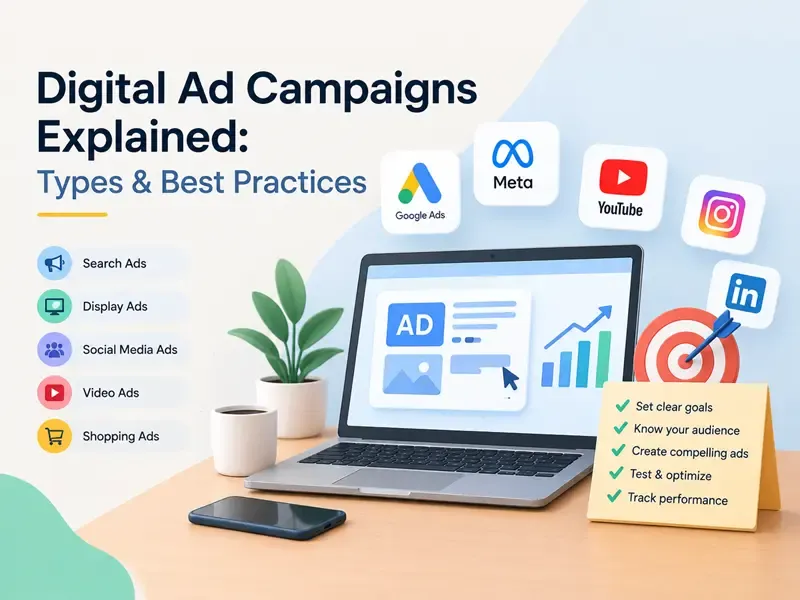
Learn the main types of digital ad campaigns and the best practices that improve results, with practical tips for beginners and growing businesses.
Every business wants to be seen by the right people at the right time. That is exactly what digital ad campaigns are built to do. A digital ad campaign is a planned series of online ads, run across one or more platforms, designed to achieve a specific goal such as sales, leads, app installs, or brand awareness. Whether you have a small budget or a large one, understanding how digital ad campaigns work is the first step toward turning ad spend into real growth.
In this guide, we break down the main types of digital ad campaigns, explain when to use each one, and share the best practices that separate profitable campaigns from wasted budgets.
What Is a Digital Ad Campaign?
A digital ad campaign is a coordinated effort to promote a product, service, or message through online channels. Unlike a single ad, a campaign has a clear objective, a defined audience, a budget, a schedule, and a set of ads that work together.
Most digital ad campaigns share the same core building blocks:
- Objective: what you want to achieve (traffic, leads, sales, awareness)
- Audience: who you want to reach, based on interests, behavior, location, or demographics
- Budget and bidding: how much you will spend and how you pay for results
- Creative: the ad copy, images, and videos people see
- Landing page: where people go after they click
- Measurement: the metrics you use to judge success
When these pieces are aligned, digital ad campaigns become a predictable, measurable way to grow your business.
Why Digital Ad Campaigns Matter
In traditional advertising, it is hard to know what worked. This is where digital advertising fills the gap. You can target specific audiences, track every click and conversion, and adjust the strategy in real time. This level of control places digital ad campaigns at the core of modern marketing strategy today.
It has more scaling potential. You can start with a small test budget, learn what works, and increase spending only on the campaigns that deliver results.
Types of Digital Advertising Campaigns
There is no single best format. The right choice depends on your goals, your audience, and where they spend their time online. Here are the most common types of digital ad campaigns.
1. Search Ads (PPC Campaigns)
Search ads appear at the top of search engine results when someone types a relevant query. Because the person is actively searching, intent is high. Google Ads and Microsoft Advertising are the main platforms.
Best for: capturing demand from people already looking for your product or service.
How it works: you bid on keywords, and you typically pay each time someone clicks your ad (pay-per-click, or PPC). Search PPC campaigns are often the first choice for businesses that want fast, high-intent traffic.
2. Social Media Ad Campaigns
Paid social ads run on platforms such as Facebook, Instagram, LinkedIn, TikTok, X, and Pinterest. Their strength is detailed audience targeting by interests, job titles, behaviors, and more. Facebook and Instagram ads are both created through Meta Ads, so you can run them from one place.
Best for: building awareness, generating demand, and reaching people who were not yet searching for you.
Tip: match the platform to your audience. LinkedIn suits B2B digital ad campaigns, while Instagram and TikTok often work well for visual consumer products.
3. Display Ad Campaigns
Display ads are banner, image, and rich media ads shown across websites, apps, and networks. The Google Display Network, for example, reaches a huge portion of internet users.
Best for: brand awareness and staying visible. Display advertising usually has lower click rates than search, but it costs less per impression.
4. Video Ad Campaigns
Video ads run on YouTube, social platforms, and streaming services. They are powerful for storytelling, demonstrations, and emotional connection.
Best for: brand building, product education, and engaging audiences who respond to visual content. Short, attention-grabbing videos usually perform best.
5. Remarketing (Retargeting) Campaigns
Remarketing shows ads to people who have already interacted with your business, such as visiting your website, viewing a product, or abandoning a cart.
Best for: bringing back warm audiences and increasing conversions. Remarketing is often among the most cost-effective digital ad campaigns because the audience already knows you.
6. Email Marketing Campaigns
Email is not always counted as advertising, but it is a core part of digital marketing campaigns. Welcome series, promotions, and re-engagement emails nurture leads and drive repeat sales at a low cost.
Best for: building relationships and encouraging repeat purchases.
7. Influencer and Affiliate Campaigns
In these campaigns, you partner with creators or publishers who promote your brand to their audiences. Influencers bring trust and reach, while affiliates are usually paid only when a sale or lead happens.
Best for: earning credibility and reaching niche communities.
8. Shopping and Native Ad Campaigns
Shopping ads show product images, prices, and store names directly in search results or feeds. Native ads blend into the look of the content around them. Both types of online advertising help ecommerce brands and content-driven businesses get discovered.
Digital Ad Campaign Best Practices
Knowing the types is only half the picture. These best practices will help you get better results from any digital ad campaign.
1. Start With a Clear Goal
Every campaign needs one primary objective. Do you want leads, sales, or awareness? A clear goal shapes your platform choice, creative, and budget. Vague goals lead to vague results.
2. Define Measurable KPIs
Choose metrics that match your goal:
- Awareness: impressions, reach, CPM
- Traffic: click-through rate (CTR), cost per click (CPC)
- Conversions: conversion rate, cost per acquisition (CPA)
- Revenue: return on ad spend (ROAS)
Track the numbers that connect directly to business outcomes, not just vanity metrics like likes.
3. Know Your Audience
The strongest digital ad campaigns speak to a specific person with a specific problem. Build audience profiles, use first-party data where possible, and test different segments. Broad targeting can work with large budgets, but narrow, relevant targeting often wins when you are starting out.
4. Write Ad Copy That Speaks to Benefits
People do not click on features. They click on outcomes. Lead with the benefit, keep your message clear, and include a strong call to action. Use language your audience actually uses, and make sure the ad matches what they will find after the click.
5. Invest in Strong Creative
In crowded feeds, visuals decide whether anyone stops scrolling. Use high-quality images or video, keep branding consistent, and refresh creative regularly to avoid ad fatigue. For most digital ad campaigns, creative quality is one of the biggest drivers of performance.
6. Optimize Your Landing Page
A great ad cannot fix a weak landing page. Make sure the page loads fast, works well on mobile, repeats the promise made in the ad, and has one clear action for visitors to take. Many campaigns lose conversions here, not in the ad itself.
7. Test Continuously
A/B testing is the engine of improvement. Test one element at a time, such as headlines, images, audiences, or calls to action, and let each test collect enough data before deciding. Small improvements add up over time.
8. Set Smart Budgets and Bids
Start with a manageable test budget, find what works, then scale gradually. Avoid changing budgets too aggressively, since sudden jumps can disrupt platform learning. Choose a bidding strategy (CPC, CPM, or CPA-based) that fits your objective.
9. Track Conversions Properly
Set up conversion tracking before you launch. Use tools such as Google Analytics, the Meta Pixel, and platform conversion tags so you know which ads produce results. Without accurate tracking, you are optimizing blind.
10. Review and Optimize Regularly
Check your digital ad campaigns on a regular schedule. Pause underperforming ads, move budget to winners, update audiences, and refresh creative. Optimization is ongoing, not a one-time task.
How to Choose the Right Type of Digital Ad Campaign
Use your goal as the starting point:
- Need quick, high-intent leads or sales? Start with search ads.
- Want to build awareness and reach new audiences? Try social, video, and display campaigns.
- Want to recover lost visitors? Add remarketing.
- Selling products online? Combine shopping ads with social and remarketing.
- Building trust in a niche? Consider influencer or affiliate partnerships.
Most successful businesses combine several types of digital ad campaigns into one connected strategy. For example, search ads capture people ready to buy, social ads create demand, and remarketing brings back everyone who did not convert the first time.
Final Thoughts
Digital ad campaigns are one of the most measurable and flexible ways to grow a business. By understanding the different campaign types and following proven best practices, you can reach the right audience, spend your budget wisely, and keep improving with every test.
Start small, track everything, and let the data guide your decisions. As your results grow, you can scale the campaigns that work and refine the ones that do not.
Need a team to manage your digital ad campaigns? Contact KIB Technologies today.