

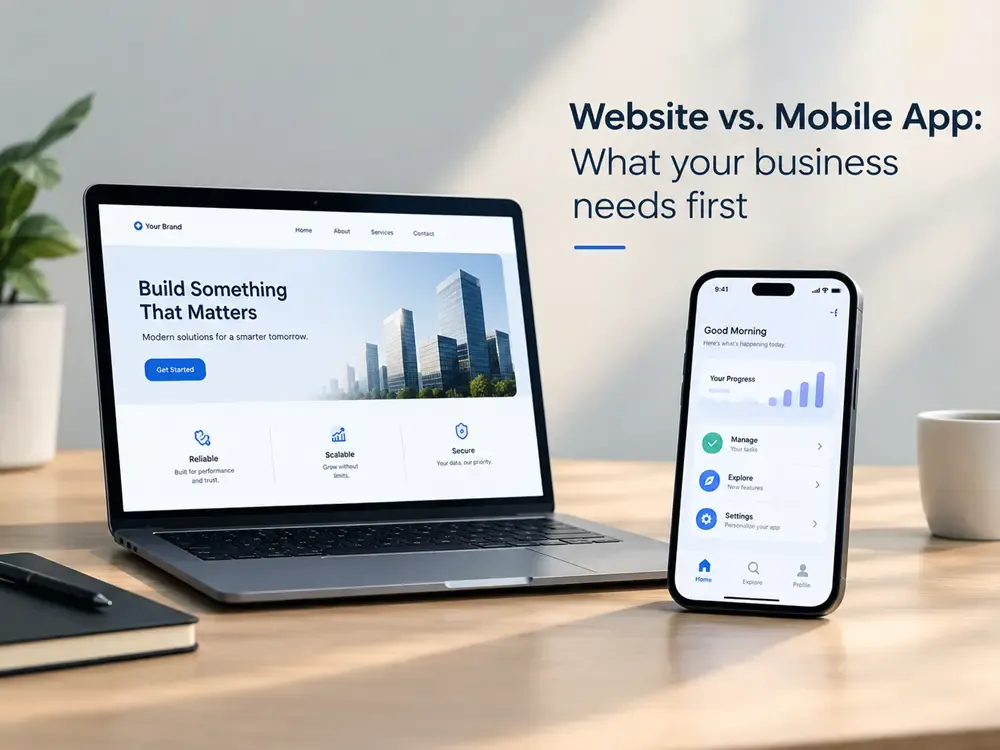
Mobile app vs website: which should your business build first? Learn why a website usually wins and when an app comes first. (
A practical guide for founders and small business owners deciding where to invest first.
Every business owner hits this fork in the road sooner or later: “Do I build a website, or should I go straight to a mobile app?” Apps feel modern and exciting. Websites feel basic and expected. But the right answer depends less on what’s trendy and more on who your customers are, how they find you, and how much you can afford to spend before you’ve proven your idea.
Here’s a clear way to think it through.
The short answer
For most businesses, build the website first. A website is cheaper, faster to launch, discoverable through Google, and works on every device. A mobile app makes sense first only in specific situations, which we’ll cover below.
Why a website usually comes first
1. People can actually find it. Customers search on Google before they download anything. A website with good content and clear information shows up in search results; an app hidden in an app store depends on people already knowing your name.
2. It builds trust. A professional website tells customers you’re real. It’s where they check your services, prices, reviews and contact details. Without one, many people will assume you’re not established.
3. Lower cost and faster launch. A solid business website can go live in weeks for a fraction of the cost of an app. A custom app often means building for iOS and Android separately (or using a cross-platform framework), plus ongoing updates, testing and store approvals.
4. Zero friction for visitors. Nobody has to download, install or sign up. They click a link and they’re in. That matters enormously when you’re a new brand asking for people’s attention.
5. It works as a testing ground. A website lets you learn what customers actually want: which pages they visit, what they search for, what they ask about. That data tells you whether an app is even worth building.
When an app should come first
There are real cases where going app-first is the smarter move:
- Your product is the app. Ride-hailing, food delivery, fitness tracking, meditation, or a mobile game. The experience itself lives on the phone.
- You need device features. Push notifications, GPS, camera, offline access, biometric login or Bluetooth are core to the value you offer.
- You expect frequent, repeat use. If customers will open it daily or weekly (banking, habit tracking, loyalty programs), an app can build a stronger habit than a website can.
- Your audience is mobile-only. If your customers rarely use desktop and expect a native experience, an app may meet them where they are.
Even then, a simple landing page is worth having so people can learn about the app and find the download link.
A quick decision guide
Your situationStart withLocal service business (salon, clinic, tutor, contractor)WebsiteOnline store or small e-commerce brandWebsite (mobile-friendly)Consultant, agency or professional servicesWebsiteContent, blog or media businessWebsiteOn-demand or marketplace platformWebsite + app (app is core)Fitness, wellness or habit-driven productApp (with a landing page)Mobile game or utility toolAppA middle path: make your website app-like
If you’re torn, you don’t have to choose between two extremes. A mobile-responsive website or a Progressive Web App (PWA) can give you much of the app experience: fast loading, home-screen icons, and even push notifications, all without an app store. It’s a smart bridge while you validate demand.
Common mistakes to avoid
- Building an app because competitors have one. Copying without a reason burns budget and rarely drives results.
- Ignoring mobile on your website. Most visitors will arrive on a phone. If your site is slow or awkward on mobile, you’ve lost them before an app even matters.
- Underestimating app maintenance. Apps need regular updates for new operating system versions, bug fixes and security. The launch is only the beginning of the cost.
- Skipping the user research. Ask a handful of real customers what they’d actually use. Their answers beat any assumption.
The bottom line
Think of your website as your digital storefront and your app as a loyalty club for people who already love you. You need the storefront first, because that’s where new customers walk in. Once you have steady traffic, repeat customers and a clear reason an app would make their lives easier, that’s the moment to build one.
Start simple. Learn from real users. Then invest where the evidence points.
Not sure which path fits your business? Write down who your customers are, how they currently find you, and what one task they’d most want to do on their phone. The answer will usually point you in the right direction. If you are looking to develop a website or mobile app for your business, contact us, and we will provide guided technology solutions tailored to your specific audience.