

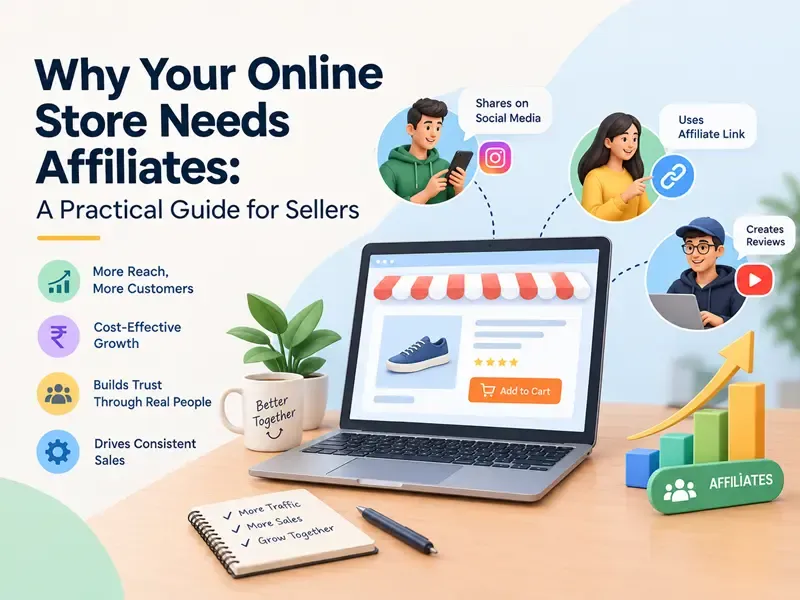
Learn why affiliate marketing works for online stores, how to set up an affiliate program step by step, and how to avoid common risks, with tips for Indian sellers.
Most online store owners know the feeling. You spend money on ads, the traffic shows up, and the moment you pause the budget, the sales dry up. Affiliate marketing offers a different deal: instead of paying for clicks and hoping they turn into orders, you pay people only after they bring you a sale.
That's why affiliate marketing for online stores has become such a popular growth channel. In this guide, we'll explain what it is, why it works, how to set up an affiliate program, which affiliates to recruit, and which risks to watch out for, including the disclosure rules that apply in India.
What Is Affiliate Marketing for an Online Store?
Affiliate marketing is a partnership. You, the seller, agree to pay a commission to someone who promotes your products and brings in a sale. That person is called an affiliate, and they could be a blogger, a YouTuber, an Instagram creator, a review website, or even a happy customer.
Here's how it works in practice:
- An affiliate joins your program and gets a unique tracking link or discount code.
- They share it in a blog post, video, social post, or newsletter.
- A shopper clicks the link and lands on your store. A small tracking file, called a cookie, remembers who sent them.
- If the shopper buys within a set time window, the affiliate earns a commission.
The key idea is that you only pay when a sale actually happens. If a post gets a thousand views and no purchases, it costs you nothing.
Why Your Online Store Needs Affiliates
You pay for results, not just attention
With most ads, you pay for impressions or clicks, whether or not anyone buys. With affiliates, the commission comes out of a sale that has already happened. That makes your spending easier to predict and your risk lower, especially when your budget is small.
You borrow trust you haven't built yet
A new store has one big problem: nobody knows it. When a creator or reviewer your audience already trusts recommends your product, some of that trust carries over to you. A genuine recommendation from a real person often does what a polished ad can't.
You reach people your ads don't
Your own ads only reach the audiences you target. Affiliates bring you in front of their audiences: a food blogger's readers, a fitness creator's followers, a deals newsletter's subscribers. Many of those people would never have seen your ads.
The content keeps working
A review post that ranks on Google or a video that keeps getting views can send you customers for months. Ads stop the day the budget ends, while good affiliate content often keeps bringing traffic long after it's published.
You depend less on one ad platform
If your sales rely on a single ad platform, one policy change or price rise can hurt badly. A healthy affiliate program spreads your risk across many partners and many sources of traffic.
It scales with you
When the program works, adding more affiliates doesn't need a bigger ad team. You recruit, support, and pay for results, and the program grows at the pace you choose.
To be honest about the trade-off: affiliate marketing isn't free. The commission is a real cost, and you'll spend time managing partners. The question is whether you'd rather pay that cost for confirmed sales than pay for traffic that might never convert.
Affiliate Marketing vs Paid Ads
The two work best together, but they behave differently:
Paid ads Affiliate marketingHow you payFor clicks or viewsA commission on each saleRiskYou pay even if no one buysYou pay only after a saleSpeedFast, starts as soon as you launchSlower, since you need to recruit partnersControlHigh control over message and targetingLess control, since affiliates create their own contentTrustSeen as advertisingOften seen as a personal recommendationA sensible approach is to use paid ads for quick, controlled traffic and affiliates for steady, trust-based growth.
How to Set Up an Affiliate Program: Step by Step
1. Make sure your store is ready
Affiliates won't send traffic to a store that doesn't convert. Before you launch, check that your product pages have clear photos, honest descriptions, visible prices and delivery details, and reviews. Make sure the store loads quickly and checks out smoothly on a phone. Otherwise, you'll pay commission on a few sales and waste the rest of the traffic.
2. Know your margins
Your commission has to fit inside your profit. Work out the margin on each product after costs, shipping, and returns, and decide how much you can give away. If a product's margin is thin, it may not suit an affiliate program, or it might need a lower commission.
3. Set your commission
For e-commerce, commissions in the range of 10% to 30% are often cited as standard, though the right number depends on your margins and your niche. Look at what competitors in your category offer, because affiliates compare programs before choosing where to spend their effort. You can start with a flat rate on every sale, then add higher tiers for affiliates who bring more orders.
4. Choose your cookie window
The cookie window is how long after a click the affiliate can still earn a commission. Shoppers often take days to decide, so a very short window feels unfair to affiliates. Many guides suggest starting with at least 30 days. For context, Amazon's well-known standard window is just 24 hours, which is one reason many affiliates prefer smaller brands with longer windows. A fair commission with a longer window can attract better affiliates than a high commission with a very short one.
5. Pick your tracking tool or network
You need software that tracks clicks and sales accurately. The main options:
- Apps and plugins for your store: Shopify has affiliate apps such as GoAffPro, UpPromote, Refersion, and ReferralCandy, while WooCommerce stores can use affiliate plugins. Features and pricing differ, so compare fraud controls and payout options before choosing.
- Affiliate networks: Networks such as Cuelinks and vCommission connect merchants with many publishers in India. They save you recruiting time, though they usually take a fee or a share of the commission.
- A custom setup: Possible for a custom-built website, but it takes development effort to get tracking right.
6. Write clear program terms
Your affiliate terms work like a contract, so write them before you recruit anyone. Cover the commission rate and cookie window, when and how you pay, which promotion methods are allowed and banned (for example, no paid ads on your brand name), and your right to remove affiliates who break the rules. Put them on a simple page on your store and link it in the footer.
7. Give affiliates what they need
The easier you make promotion, the more affiliates will do it. Prepare product photos, short descriptions, banners, and a few ready-to-use messages. Offer each affiliate a unique link and, if they want one, a discount code for their audience.
8. Recruit your first affiliates
Start close to home. Email your existing customers and ask your most enthusiastic ones to join. Then reach out to small creators and bloggers in your niche. Add a "Become an affiliate" page to your site, and consider listing your program on a network. A handful of good partners beats a long list of inactive ones.
9. Track, support, and pay on time
Check results every week: clicks, orders, average order value, and returns for each affiliate. Pay on the schedule you promised. Nothing damages a program faster than late payments.
Which Affiliates to Recruit
Not every affiliate is the same, and each brings something different:
- Bloggers and reviewers: Their articles can rank on Google and bring steady traffic from people comparing products.
- Micro-influencers: Creators with smaller, loyal audiences, whose followers tend to trust their picks. Ideal for fashion, beauty, food, and lifestyle products.
- YouTubers: Strong for products that need a demonstration, such as gadgets or home goods.
- Newsletter owners: Their subscribers have already chosen to hear from them, which makes recommendations land well.
- Your own customers: People who already love your product often make the most believable promoters.
- Coupon and cashback sites: They can bring volume, but they often target shoppers who were about to buy anyway. Use them selectively and set clear rules.
Practical Tips to Keep Your Program Healthy
- Reward your top performers. Offer higher commission tiers, bonuses, or early access to new products for affiliates who deliver.
- Run boosts around big sale seasons. A temporary commission increase during festive periods gives affiliates a reason to push you harder.
- Send samples. Creators promote products they've actually tried, and honest reviews convert better.
- Check traffic quality, not just volume. Compare each affiliate's average order value and return rate with your store average. If an affiliate's customers spend much less or return more, they may be attracting bargain hunters rather than your ideal buyers.
- Keep in touch. A short monthly email with top products, new offers, and updated assets keeps your program in affiliates' minds.
Risks and How to Handle Them
Affiliate marketing works well, but it isn't risk-free. Watch for these:
- Coupon leaks. Discount codes meant for one creator's audience can end up on public coupon sites, so regular customers use them and you pay commission on sales you'd have made anyway. Use unique codes, set usage limits, and review commissions before paying them out.
- Brand bidding. Some affiliates run search ads on your brand name and collect commission on shoppers who were already looking for you. Ban it in your terms, and regularly search your brand name with words like "coupon" or "discount" to check.
- Tracking manipulation. Dishonest partners can use tricks such as cookie stuffing to claim credit for sales they didn't influence. Choose a tracking tool with fraud controls, and review unusual spikes.
- Thin margins. If commissions eat your profit, adjust the rate or exclude low-margin products.
- Misleading claims. An affiliate who exaggerates your product can hurt your reputation. Give clear guidelines on what they can and can't say.
Not every unusual number means fraud, but every unusual number deserves a look.
Disclosure Rules for Indian Sellers
If you work with affiliates and influencers in India, disclosure isn't optional. The Advertising Standards Council of India (ASCI) requires influencers to clearly label content when they have a material connection with a brand, and legal summaries note that this includes money, free products, and discounts. The Central Consumer Protection Authority (CCPA) has similar endorsement guidelines, and advisers note that disclosures must be prominent and not hidden among hashtags or links. Penalties for failing to disclose can be serious, and responsibility doesn't rest only with the influencer: advertisers are expected to make sure it happens too.
In practice, add a disclosure requirement to your affiliate terms, remind your affiliates to label affiliate links and sponsored posts clearly (with wording such as "Ad" or "Affiliate link"), and check their posts now and then. Since rules and guidance can change, it's worth confirming the current requirements with ASCI and CCPA, or with a legal adviser, before you launch.
If You Sell on Amazon or Flipkart
If your products are sold through marketplaces rather than your own site, you can still benefit indirectly. Affiliates who promote products through Amazon's or Flipkart's own programs earn commission from those platforms, so your listings can get attention from them without any setup on your side. The catch is that you don't control the commission or the partner relationships. A program on your own store gives you that control and your own customer data, which is why many sellers do both.
Mistakes to Avoid
- Launching before your store converts. Fix product pages and checkout first.
- Setting commissions without checking margins. Growth that loses money isn't growth.
- Choosing a very short cookie window. Good affiliates will go elsewhere.
- Recruiting many, supporting none. A few active partners are worth more than a hundred silent ones.
- Ignoring tracking and fraud checks. Review results and commissions before every payout.
- Skipping disclosure rules. It exposes both you and your affiliates to risk.
Final Thoughts
Affiliate marketing for online stores isn't a magic trick. It's a steady partnership model: you give people a fair reason to recommend you, make it easy for them, and pay them when it works. Start small, with a clear commission, simple terms, and a handful of the right partners, and let the numbers tell you when to grow.
Want to grow your online store? KIB Technologies builds websites and runs digital marketing campaigns for growing businesses. Talk to our team and plan your next step.