

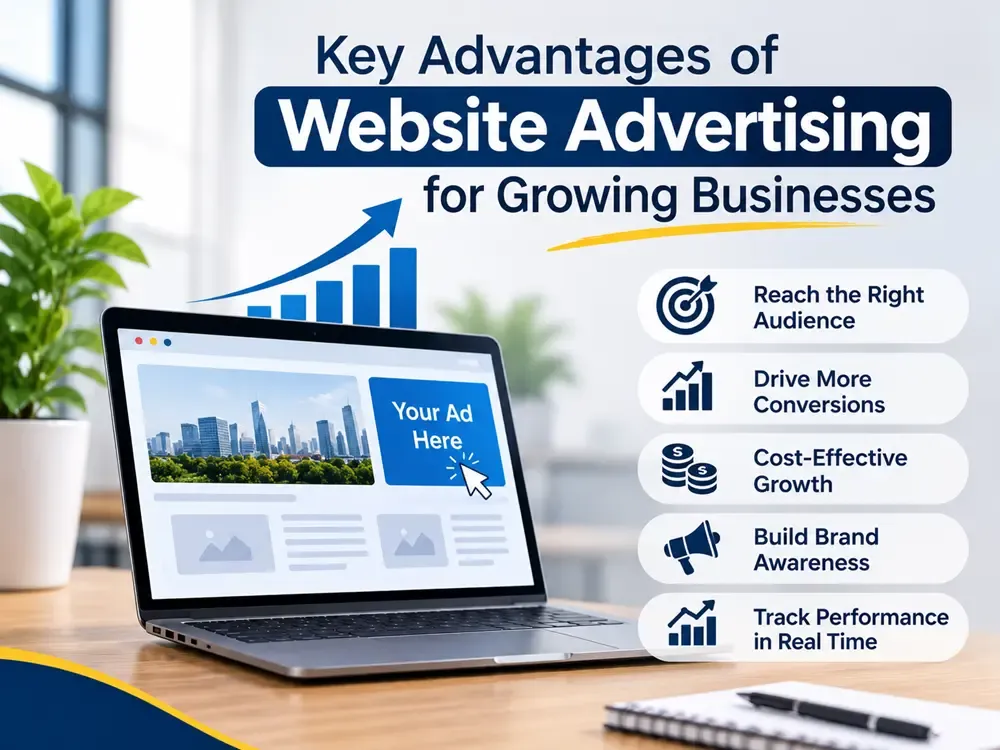
Think of your website as your shop's address on the internet. It is the one place customers can always find you, open at any hour, with your products, prices, and proof in one place. But an address only helps if people know it exists. That is where website advertising comes in: it puts your brand in front of people on pages they already visit and points them back to your site.
This guide helps you understand how website advertising works and why it benefits growing businesses. You will learn the basic ideas, the key terms, and simple examples you can relate to, so you can decide whether and how to use it.
What Is Website Advertising?
Website advertising means paying to show your ads on other websites and apps so that interested people click through to your own. The site or app that shows your ad is called the publisher, and the ad is usually a banner, an image, or a sponsored placement. You will also hear it called display advertising.
Here is how it works. You create an ad and decide who should see it. An ad network or programmatic advertising platform, such as the Google Display Network, matches your ad with suitable websites. You then pay either for every thousand times your ad is shown, known as CPM, or each time someone clicks it, known as CPC. The ad becomes a small signpost that leads people to your landing page.
How you see it in real life: You open a cricket score page and notice a banner for a mutual fund app across the top. A few days later, the running shoes you looked at in an online store appear in an ad on a recipe page. That second case is called retargeting, and we will come back to it.
Learn More: Types of Digital Advertising
Benefits of Website Advertising
1. Wider Visibility and Reach
The first advantage is the simplest: more people get to see you. When your ad appears across many websites, you no longer wait for customers to search for your name. This matters most for new brands, because people rarely buy from a name they have never come across. Seeing a brand a few times builds familiarity, and that growing familiarity is what marketers mean by brand awareness.
India gives this a big stage. The IAMAI-Kantar Internet in India report 2026 counts about 950 million active internet users, with rural India making up more than half. Many of them prefer content in their own language, so ads in Hindi, Tamil, Marathi, or Bengali can reach people that English-only ads would miss.
Example: A regional snack brand runs Gujarati banner ads on local news and recipe sites. Within weeks, more shoppers recognise its packet on the shelf.
2. Targeted Marketing Opportunities
Showing your ad to everyone wastes money, so targeting lets you choose who sees it. There are a few common ways to do this. You can target by topic, such as running-shoe ads on fitness articles. You can target by interest or past behaviour, by location, or by device. You can also pick specific websites where your audience spends time, which are called ad placements.
Targeting works best when you already know your customer well: their age, city, interests, and the sites they read. The clearer that picture, the fewer ad impressions are wasted on people who will never buy.
Example: A coaching institute shows its entrance-exam course to students and parents on education sites in three nearby cities, instead of paying to reach the whole country.
3. Cost-Effective Advertising With Flexible Budgets
Website advertising does not demand a large fixed commitment. You set a daily or monthly ad budget, pay only for the impressions or clicks you buy, and can pause or change the spend whenever you like. For a small business, that control is valuable.
One idea is worth understanding here. Display clicks usually cost much less than search clicks, because people browsing a website are not yet looking to buy, unlike someone who searches for a product. So cost-effective does not mean cheap clicks. It means a fair cost for each lead or sale. Display is often best at building awareness cheaply, while other channels close the sale.
Example: A boutique hotel spends a small daily amount on banner ads to stay visible before wedding season, while its search ads capture people ready to book.
4. Measurable Results: Know What Works and What Doesn't
Every ad platform shows you what happened to your money. Learning four terms helps you read it. Impressions are the number of times your ad was shown. Click-through rate (CTR) is clicks divided by impressions, which tells you how many viewers found the ad interesting. A conversion is the action you want, such as a purchase or form fill, and the conversion rate is the share of visitors who take it. Return on ad spend (ROAS) is revenue earned for each rupee spent.
One subtle point: display ads are easy to scroll past, so clicks do not tell the whole story. A person may see your ad, ignore it, and buy later through a search. That is why it helps to look at conversions and total results, not clicks alone.
Example: A fitness app tests two banners, one with a price offer and one with a transformation story. After two weeks, the story banner brings cheaper sign-ups, so the budget moves there.
5. Flexibility in Scaling
Website advertising lets you grow at your own pace. A sensible approach is to start small, test a few ad designs and placements, and increase spend only on what works. You can also raise your budget for festive seasons like Diwali and lower it afterwards.
Scaling has two things to watch. First, costs can rise as more advertisers compete for the same audience, so increase the budget in steps. Second, people get tired of seeing the same ad, which is called ad fatigue. Refresh your creatives every few weeks so results do not fade.
Example: An online jewellery store doubles its budget only on the two banner designs that brought the most orders, and pauses the rest.
6. A Competitive Edge in the Digital Landscape
The earlier advantages come together here. Your banner can appear on the same websites as a national brand's. And because small businesses decide quickly, you can change a headline, shift a budget, or launch an offer within days while larger competitors wait for approvals.
Retargeting is one of the clearest ways a smaller brand can compete. Most online shoppers leave without buying; the Baymard Institute's research puts average cart abandonment at about seven in ten. Retargeting gently reminds those interested visitors to come back, without spending to find new ones. The edge comes from focus and speed, not from outspending anyone.
Example: A home decor start-up shows the exact lamp a visitor viewed, with a free-delivery offer, on the sites that visitor browses next.
When Website Advertising May Not Be the Right Fit
Website advertising is not the best starting point for every business. If you need instant sales from people ready to buy today, search ads usually reach them faster. If your landing page is slow, confusing, or hard to use on a phone, ads will send visitors to a page that loses them. If you cannot track results, you will not know what to fix. And if your audience is very small, such as a narrow business niche, broad display may waste money. In these cases, fix the basics first or begin with a more intent-led channel.
How to Get the Most Out of Website Advertising
The advantages above only appear when a campaign is set up well. These steps help.
- Choose one clear goal. Decide whether you want awareness, website traffic, or leads. One campaign should have one goal.
- Pick ad placements that match your audience. Choose sites your customers actually read, not just the busiest ones, and exclude poor-quality sites.
- Match the ad to the landing page. The offer, language, and design should continue from the banner to the page, and the page should load quickly on mobile.
- Use retargeting. Bring back visitors who viewed a product or started a form.
- Test one thing at a time. Change a headline, image, or call to action, then compare results before changing anything else.
- Start small, then scale winners. Run a small test for two to four weeks, then raise the budget on what works.
- Avoid common mistakes. Do not run too many placements at once, keep the same creative for months, or judge success by clicks alone.
Conclusion
Website advertising helps growing businesses get noticed, reach the right people, spend flexibly, understand their results, scale with confidence, and compete with bigger brands. It works best when you start with a clear goal, a small budget, and a landing page that is ready for visitors.
Ready to grow? Start website advertising today. With Kib Technologies, get your website built and reach a wider audience.