
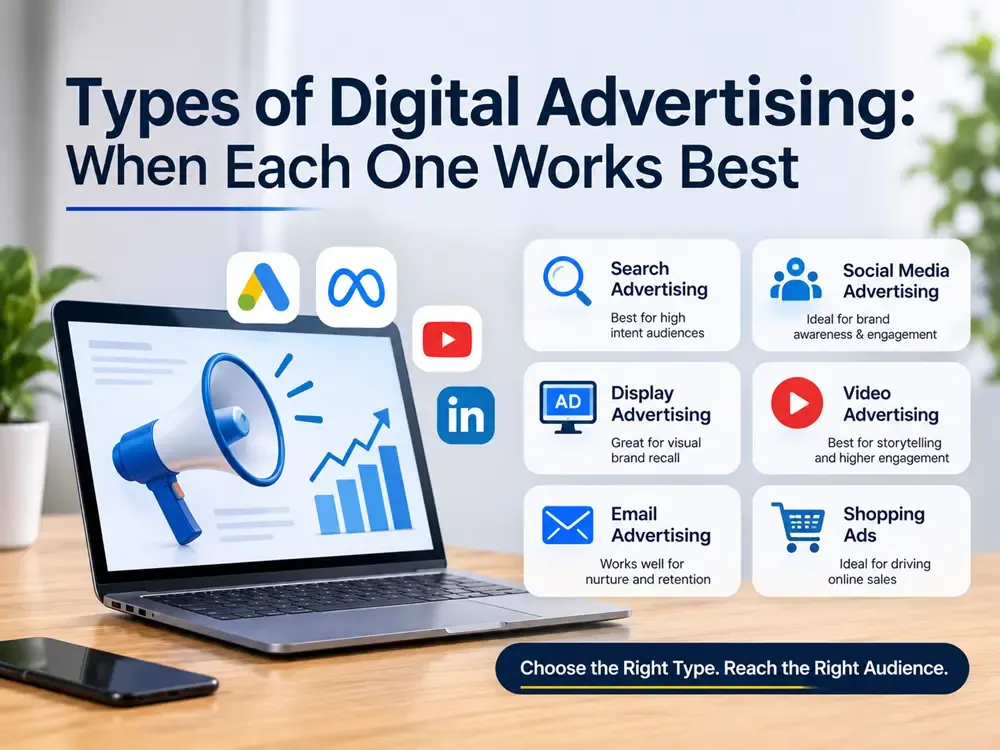
Types of digital advertising explained for Indian businesses: what each ad is, when and how it works best, so you can spend smarter.
Digital advertising is now the centre of India's ad economy. It will experience exponential growth in the near future, as research suggests.
Most guides explain what each ad format is. This one helps you decide which of the main types of digital advertising fits your business, your target audience, and your ad budget. For each type, you will see who it suits, when it works best, when to avoid it, and what the data says.
Here are the main types of Digital Advertising
1. Search Advertising (Paid Search or PPC)
What it is: Search advertising places short text ads on search engine results pages (SERPs) when someone types a related keyword. You bid on keywords and pay only when a person clicks, which is why it is also called pay-per-click (PPC).
How you see it in real life: Search "best running shoes" on Google. The first few results, carrying a small "Sponsored" label above the usual listings, are paid search ads.
Best for: Businesses whose customers already search for a solution, such as clinics, coaching institutes, real estate agents, repair services, and e-commerce stores. Search engine marketing works on a pay-per-click (PPC) basis, so you reach people who are already close to buying.
Works best when: You have a clear offer, a landing page that loads fast on mobile, and enough budget to get through the early learning phase. It is also a strong fit as more users in smaller cities search by voice and in regional languages.
Avoid when: Your product is so new that nobody searches for it yet, or your keywords are so competitive that each click costs more than a sale is worth.
Example: A dental clinic in a mid-sized city runs ads for "root canal near me" in Hindi and English. Every click comes from someone with an active need, which makes lead generation predictable.
Also Read: Digital Ad Campaigns Explained: Types & Best Practices
2. Social Media Advertising
What it is: Social media advertising means paid posts, stories, Reels, or videos shown inside platforms like Instagram, Facebook, LinkedIn, and YouTube. You choose who sees them by age, interests, location, or behaviour.
How you see it in real life: While scrolling Instagram Reels, you see a brand video with "Sponsored" under the account name and a "Shop now" button at the bottom.
Best for: Brands that need to build awareness, tell a story, and reach a specific audience by age, interest, or city. Fashion, food, beauty, education, and D2C brands benefit most.
Works best when: Your product is visual or emotional, and you can produce fresh creative regularly. Social media ads help most at the top and middle of the sales funnel, where people discover you rather than search for you.
Avoid when: You expect instant sales from cold audiences with a weak offer, or you cannot refresh creatives. Ad fatigue sets in fast.
Example: A homegrown skincare brand targets women aged 22 to 35 with short Reels showing before-and-after routines, then retargets viewers with a first-order discount.
Also Read: Social Advertisement: Ad Types, Best Channels and Budget Tips
3. Display Advertising
What it is: Display advertising uses image-based banner ads placed on websites and mobile apps that sell ad space. They can be static, animated, or interactive, and they are usually bought on a cost-per-thousand-impressions (CPM) basis.
How you see it in real life: You read a news article and see a banner at the top or in the sidebar. After browsing a pair of shoes, the same shoes then "follow" you across other websites.
Best for: Brand recall and remarketing. Banner and image ads across websites and apps keep your brand visible to people who already visited your site.
Works best when: You use it as a supporting channel. Display retargeting, also called remarketing, reminds visitors who left a cart or a pricing page to come back. Programmatic advertising can also help you buy placements at scale.
Avoid when: You expect it to be your main source of direct sales. Display ads are easy to ignore, and low-quality placements waste money.
Example: An online furniture store shows the exact sofa a visitor viewed, plus a limited-time offer, over the next week.
4. Video Advertising
What it is: Video advertising puts short promotional videos before, during, or between video content. They run on platforms like YouTube, Shorts, and OTT streaming apps, and are measured by views, view rate, and cost per view.
How you see it in real life: You tap a YouTube video and a 15-second ad plays first, with a "Skip Ad" button appearing after five seconds.
Best for: Brands that want mass reach, trust, and storytelling. Online video suits consumer products, apps, education platforms, and anything that is easier to show than to explain.
Works best when: You have a strong first five seconds and your audience watches on mobile. YouTube and in-stream placements work for both brand awareness and consideration.
Avoid when: You have no video budget or no clear message. A poorly made video can hurt more than help.
Example: A language-learning app runs 15-second Hindi and Tamil YouTube Shorts ads, showing a user speaking a new sentence after one week.
5. Native Advertising
What it is: Native advertising is paid content designed to match the look and feel of the page it appears on, so it reads like part of the site rather than an interruption. It is always labelled, usually as "Sponsored" or "Promoted."
How you see it in real life: At the bottom of a news article, you see a "Promoted stories" block with headlines and thumbnails that look just like the site's own articles.
Best for: Content-led brands, fintech, edtech, and publishers' audiences who prefer reading to being interrupted. Native ads match the look of the page, such as sponsored articles or recommended content blocks.
Works best when: You have genuinely useful content and a longer decision cycle, so education comes before the sale.
Avoid when: The ad is a thin sales pitch dressed up as an article, or you need immediate conversions. Readers notice and lose trust.
Example: A personal finance app sponsors a Hindi explainer on first-time investing, with a soft call to download its calculator.
6. Email Advertising
What it is: Email advertising means sending promotional messages straight to the inboxes of people who have shared their address with you, such as newsletters, offers, and automated reminders. You own the list, so you are not renting attention from a platform.
How you see it in real life: You leave a jacket in your online cart, and a few hours later an email arrives saying "You left something behind," with a button to complete your order.
Best for: Businesses with an existing list of customers or leads. It is one of the most cost-effective forms of digital marketing for repeat purchases, customer retention, and reactivation.
Works best when: You use automation. Welcome series, abandoned-cart reminders, and back-in-stock alerts reach people when interest is highest.
Avoid when: You are starting from zero with no subscribers, or you plan to buy lists. That damages deliverability and your reputation.
Example: A fashion store sends a reminder two hours after someone abandons their cart, then a discount if they still have not bought after a day.
Also Read: Email Marketing: A roadmap to successful campaigns
7. Influencer Advertising
What it is: Influencer advertising is when a brand pays or partners with a content creator to promote a product to their followers. The audience trusts the creator's recommendation, which makes it feel more personal than a standard ad.
How you see it in real life: A food creator on Instagram shows a tea brand in a recipe video, with a "Paid partnership" label and a discount code in the caption.
Best for: D2C, beauty, fashion, food, and lifestyle brands that rely on trust and word of mouth, especially when targeting regional audiences.
Works best when: You choose creators whose audience truly matches your customer, and build long-term partnerships rather than one-off posts. Micro and nano influencers often deliver more engagement per rupee.
Avoid when: You choose by follower count alone, or you have no way to track results through codes or links.
Example: A tea brand partners with five Marathi food creators for three months, each sharing a unique discount code.
8. Affiliate Advertising
What it is: Affiliate advertising is a performance-based model where partners promote your product using a unique tracked link. You pay them a commission only when a sale, sign-up, or lead happens through that link.
How you see it in real life: You read a blog post titled "Best headphones under ₹3,000" and click its "Buy now" link. If you purchase, the blogger earns a small commission.
Best for: Ecommerce, SaaS, and course sellers who want to pay only when a sale or lead happens. Bloggers, comparison sites, and cashback platforms promote your product for a commission.
Works best when: Your margins can support a commission, and your product has a clear tracking path from click to purchase.
Avoid when: Your margins are thin, or you cannot monitor partners. Poor-quality affiliates can bring low-intent traffic or misuse coupon codes.
Example: An online course platform pays a 20% commission to career bloggers for every enrolment their readers complete.
Also Read: Why your online store needs Affiliates
How to Choose the Right Type
Start with your goal. If you want sales from people already looking, begin with search. If you need awareness, start with social or video. If you already have visitors or subscribers, use display remarketing and email to bring them back. If trust is your biggest barrier, add influencers.
Next, match your budget. Small budgets usually do best with one or two channels, typically search plus one social platform, because spreading money thin makes it hard to learn anything. Finally, remember that the best ad campaigns combine channels: video or social for discovery, search for intent, and email for retention.
Final Thoughts
There is no single best type of digital advertising, only the best fit for your audience, funnel stage, and budget. Pick one primary channel, test it for a few weeks, track metrics such as CTR, conversion rate, and return on ad spend (ROAS), and expand only when the numbers justify it. Treat benchmarks as a map, not a destination, and let your own results guide the next rupee you spend.
Looking to promote your business through Digital Advertising. Contact Kib Technologies; we provide the best advertising services tailored to your needs and audience interests.